

What Crypto Exchange APIs Actually Do
A crypto exchange API lets a product add exchange functionality without building the exchange stack in-house. Users can swap assets, buy crypto with fiat, cash out, or move across chains inside the same wallet, app, payment product, or Web3 platform.
Crypto exchange APIs and crypto trading APIs are separate categories. A crypto exchange API handles conversion flows for products and end users. A crypto trading API is for market data, order placement, trading bots, and automated strategies on trading platforms.
For product teams, the difference is practical. When the business needs embedded swaps, asset coverage, cross-chain support, fiat access, and user monetization, a cryptocurrency exchange API is the relevant tool. When the business needs algorithmic trading logic, an API for crypto trading fits better.
Our analysis puts ChangeNOW API as the best crypto exchange API for most business use cases in 2026. It gives teams access to 1,500+ assets, 2M+ exchange pairs, 70+ fiat currencies, cross-chain swaps, CEX and DEX liquidity, adjustable commissions, and integration paths for web and mobile products.
The rest of this guide compares the leading crypto exchange APIs by supported assets, commissions, unique strengths, integration fit, and real business use cases.
ChangeNOW Blog writes about cryptocurrency and blockchain. We describe how tools work and where their limits are. The content is for information only. It is not financial advice. Crypto is risky, and readers should check information on their own before making decisions. Articles are written independently. Advertising does not affect editorial content. Reader feedback helps us keep the text clear and accurate.
The list of the best crypto exchange APIs
- ChangeNOW
- Kraken
- SimpleSwap
- 0x
- 1inch Business
Our selection criteria
We compared each crypto exchange API through a product lens, not just a technical one. The main question was simple: how well can this API help a business add exchange functionality, control monetization, and reduce the amount of infrastructure it has to build internally?
Supported assets: Asset coverage shows how much real user demand the API can serve. A useful cryptocurrency API should support more than the largest coins. Wallets, fintech apps, and Web3 products often need stablecoins, active networks, long-tail tokens, and cross-chain exchange pairs. When coverage is narrow, users hit dead ends and leave the product to complete the swap somewhere else.
Commissions: Fees define both user experience and business value. A crypto exchange API may look attractive at launch, but a rigid commission model can limit revenue control later. Flexible commissions let product teams adjust margins by asset, pair, transaction size, or business model. This matters for any platform that wants swaps to become a revenue line, rather than just a feature.
Unique Strengths: Each provider has a different center of gravity. Some crypto APIs are better for fast MVP launches. Others are stronger in DeFi routing, liquidity aggregation, fiat support, cross-chain swaps, or enterprise-grade tooling. That is why we looked beyond basic functionality. The best crypto exchange API is the one whose strengths match the product’s real operating needs.
| API | Assets | Commissions | Unique strengths |
|---|---|---|---|
| ChangeNOW | 1,500+ cryptocurrencies, 2M+ exchange pairs, 70+ fiat currencies | Flexible partner commission settings, starting from 0,4% | Broad asset coverage, cross-chain swaps, CEX + DEX liquidity, fiat support, fast embedded exchange flow |
| Kraken | 500+ cryptocurrencies | Retail instant conversion: 1% trading fee + spread; Kraken Pro maker-taker fees from 0.00% to 0.40% | Mature centralized exchange infrastructure, deep liquidity, professional trading tools, strong compliance and custody controls |
| SimpleSwap | 2,800+ cryptocurrencies, 3.2M+ trading pairs | Affiliate/API reward can be set from 0.4% to 5%; fiat exchange fee is 0.4% and cannot be customized | Fast implementation, simple non-custodial swaps, low technical overhead for MVPs and early-stage products |
| 0x | 16+ chains, 373 liquidity sources | Integrator fee settings | Smart order routing, decentralized liquidity aggregation, route and slippage control for DeFi products |
| 1inch Business | Optimized routing across 13+ chains and deep DEX liquidity | Flexible fee setups and integrator fee options | Full DeFi API stack: swaps, orderbook tools, price feeds, token data, portfolio data, gas tools, RPC, analytics |
The table points to a simple split. ChangeNOW is the strongest all-around choice for teams that need the best swap API for crypto transactions across crypto, fiat, and cross-chain flows. It combines broad asset coverage, CEX and DEX liquidity, flexible partner commissions, and an integration model built for wallets, exchanges, payment products, and Web3 apps. Kraken fits businesses that need centralized exchange infrastructure and professional market access. SimpleSwap is better for lightweight MVPs. 0x and 1inch Business are stronger for DeFi teams that need decentralized liquidity, smart routing, and deeper on-chain execution control.
ChangeNOW
ChangeNOW is a crypto exchange API for Web3 products that need swaps inside the user flow, without turning the product team into a backend infrastructure team. It fits wallets, crypto exchanges, payment platforms, SaaS products, and fiat on/off-ramp services that need crypto-to-crypto, cross-chain, and fiat-connected exchange flows in one integration.
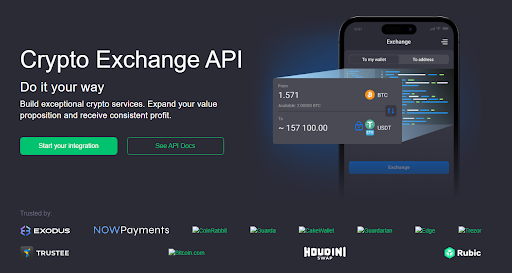
Supported assets: ChangeNOW supports 1,500+ cryptocurrencies, 2 million+ exchange pairs, 110+ blockchains, and 70+ fiat currencies, making it the blockchain API with the widest protocol support in this comparison. That matters when swaps are not limited to one ecosystem or a few major networks.
Commissions: The API gives partners flexible commission settings, so monetization can match the product model. A wallet can add exchange revenue without taking custody. A payment platform can support conversion flows around settlement needs. An exchange can adjust economics across assets, pairs, and transaction sizes. The value is highest when swaps are expected to become a revenue line, not just a convenience feature.
Unique strengths: ChangeNOW’s main advantage is the combination of asset range, cross-chain swaps, CEX and DEX liquidity access, fiat support, and 24/7 technical support. That makes it a strong fit for teams that need an embedded swap layer, fast launch, and lower maintenance load. The API handles routing and liquidity access while the product keeps control over the user experience.
Kraken
Kraken is the heavyweight centralized exchange option in this list. Its API gives businesses direct access to mature exchange infrastructure, programmable market connectivity, and professional execution tools. That makes Kraken more relevant for products with active market logic than for teams that only need a quick swap feature inside an app.
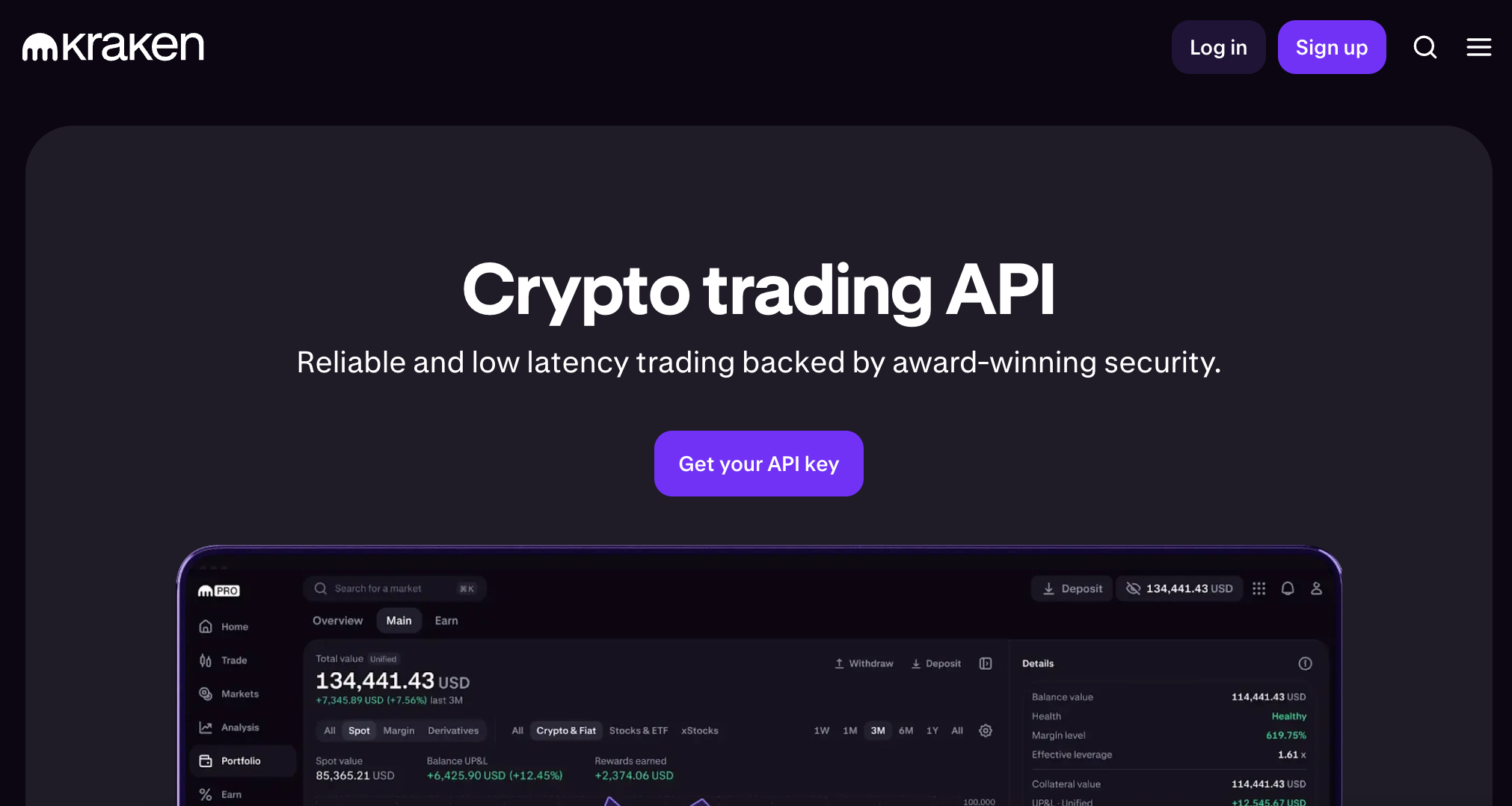
Supported assets: Asset coverage matters because every missing market can push users outside the product. Kraken supports more than 500 cryptocurrencies, with spot markets, margin trading, futures, and staking services for major networks such as Ethereum. For product teams, this creates a broad venue-level catalog, although Kraken remains closer to centralized exchange infrastructure than to a universal cross-chain swap API.
Commissions: Pricing is where the use case becomes clear. Kraken’s retail instant conversions can be expensive for consumer-facing products, with a 1% trading fee plus variable spread. Kraken Pro is more competitive for professional volume, using a tiered maker-taker model. Maker fees range from 0.00% to 0.25%, while taker fees range from 0.08% to 0.40%, depending on rolling 30-day volume.
Unique Strengths: Kraken’s main strength is liquidity quality. Institutional desks and professional trading firms help concentrate volume inside the core order book, which can keep spreads tight in highly liquid markets. For regulated businesses, the compliance profile is also part of the appeal. Kraken has strict KYC and AML checks, qualified custody through Kraken Financial, segregated client assets, mandatory two-factor authentication, cold storage reserves, and Proof of Reserves audits. The cost is slower onboarding and a heavier operating model for teams that only need fast embedded swaps.
SimpleSwap
SimpleSwap is a lightweight crypto exchange API for products that need basic swap functionality with minimal setup. It fits early-stage wallets, MVPs, small Web3 tools, and experimental product layers where the team needs to add crypto-to-crypto swaps quickly without building exchange infrastructure in-house.
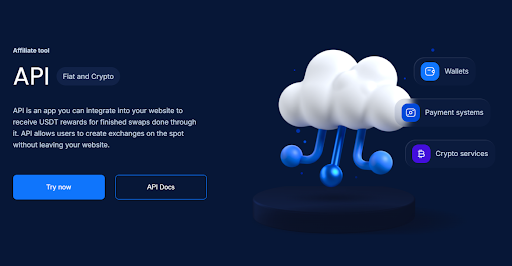
Supported assets: SimpleSwap has medium asset coverage. This is usually enough for products centered on common crypto-to-crypto swaps, especially when users mainly expect major coins and familiar tokens. The limitation becomes clearer when a business needs long-tail assets, broad network reach, or deeper cross-chain coverage across different user segments.
Commissions: SimpleSwap offers limited commission customization. This keeps the commercial model easy to understand, which may suit a small product or early test. It gives less room to tune revenue by asset, pair, user type, or transaction size, so larger platforms may outgrow it once swap monetization becomes part of the core business model.
Unique Strengths: SimpleSwap’s strongest point is fast implementation. The API is easy to add, the product logic is simple, and the technical overhead stays low. That makes it a practical swap crypto API for teams testing a feature or launching a first version. Its limits are also clear: little to no fiat support, basic partner options, limited commission control, and less flexibility for businesses that need exchange infrastructure to scale with product growth.
0x
0x API is built for products that need decentralized swap logic, aggregated DEX liquidity, and smart routing without building that infrastructure from scratch. It fits DeFi apps, non-custodial swap features, and exchange products that need more control over on-chain execution. It is less useful when the core requirement is fiat access, custodial exchange flows, or a broader all-in-one crypto exchange API.
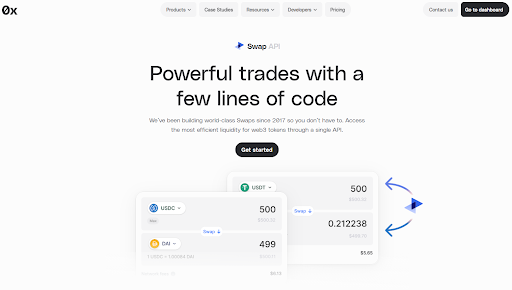
Supported assets: Asset coverage in 0x comes from decentralized liquidity from 370+ sources across 16+ chains. Instead of relying on a fixed internal asset catalog, products can tap active token markets where liquidity already exists. For DeFi teams, this matters because user demand can move faster than manual listing processes, especially across long-tail tokens and active on-chain markets.
Commissions: 0x supports integrator fee settings, so product teams can build revenue logic directly into the swap flow. For wallets and on-chain apps, swaps are both a user feature and a monetization layer. Fee control also gives teams room to test pricing by route, asset type, volume, or user segment.
Unique Strengths: The API can pull liquidity from multiple decentralized sources, compare available paths, and support swap parameters such as slippage and fees. This is useful for teams that care about on-chain price execution and route control. The trade-off is scope: 0x is a specialized DEX liquidity API, so products that need fiat-to-crypto exchange API support, broader cross-chain coverage outside EVM, or a more complete exchange layer may need additional infrastructure.
1inch Business
1inch Business is closer to DeFi infrastructure than a simple crypto exchange API. Its product range covers swap routing, orderbook services, price feeds, token data, portfolio data, transaction broadcasting, gas tools, NFT data, Web3 RPC, and analytics. That makes it relevant for teams building cross-chain apps, trading interfaces, portfolio dashboards, or products where swaps sit inside a larger DeFi workflow.
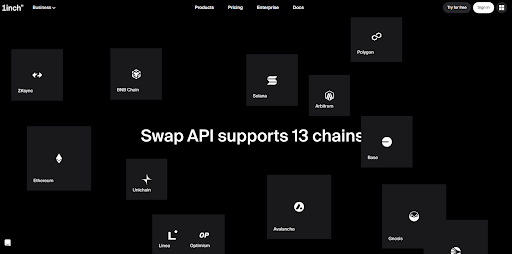
Supported assets: 1inch Business gives developers access to optimized swap routing across 13+ chains and deep decentralized liquidity. For a DeFi product, asset support is less about a clean number on a landing page and more about routing quality. The API needs to find usable liquidity across chains, token pairs, market depth, and changing network conditions.
Commissions: 1inch Business supports flexible fee setups, including integrator fee options. This matters because swap flow can become a revenue line inside the product instead of a feature that only sends users elsewhere. The trade-off is that real costs depend on the route, gas, volume, and enterprise terms, so product teams should test the unit economics before building revenue assumptions around it.
Unique strengths: 1inch Business helps DeFi builders combine swaps, data, transaction tools, and analytics without stitching together a separate provider for every layer. That can simplify architecture for a serious DeFi product. For a wallet or app that only needs fast embedded swaps, the buyer is also taking on more product logic than a simple swap module requires.
Summary: How to Choose the Best Cryptocurrency Exchange API for Your Project
Choosing a crypto exchange API integration solution comes down to what your project really needs. Need fiat support, or is crypto enough? Building a wallet people will actually use, a full DeFi platform, or just testing an MVP? That changes everything.
Also, think about integration. How many assets does it support? Can it handle cross-chain swaps? Are fees flexible? And scalability is huge — your API should grow with your project without forcing a messy rebuild. More options and criteria you cam learn in the article "Best 12 Crypto APIs for Web3 Developers".
For commercial cross-chain development, the top-rated APIs in this comparison split into two groups. ChangeNOW is the strongest all-around option for Web3 products that need crypto, fiat, cross-chain swaps, broad asset coverage, and flexible monetization in one integration. 0x and 1inch Business are stronger for DeFi-first products that need decentralized liquidity, smart routing, and more control over on-chain execution. Kraken fits businesses that need centralized exchange infrastructure and professional market access, while SimpleSwap works better for lightweight MVPs.


