

In 2026, ADA is sitting roughly 90% below its all-time high, and, at the same time, in the US strategic crypto reserve proposal alongside Bitcoin, fresh off a completed governance hard fork. The logic seems off, right?
Let’s look at what data is showing us.
Disclaimer: Here you'll find facts, verified data, and general market analysis to help you form your own view on ADA as an asset. This content is for informational purposes only and does not constitute investment advice or a recommendation to invest in any crypto asset. Whether any crypto asset is a “good investment” depends on your individual circumstances and risk tolerance.
Key Takeaways
- Massive price discount: ADA sits 90% below its all-time high but maintains strong structural support with over 63% of its circulating supply actively staked.
- Regulatory & ETF catalysts: Near-term investment upside is tied to an October 2026 spot ETF decision deadline and a 72% probability of achieving digital commodity status via the CLARITY Act.
- Severe DeFi & revenue lag: The core bearish argument centers on low commercial utility, highlighted by monthly network fees dropping below $40,000 and an 82% collapse in DeFi TVL since late 2024.
- Enterprise privacy edge: The Midnight sidechain offers compliance-friendly transaction privacy, giving Cardano an institutional use case that Ethereum and Solana lack at the base layer.
- High bitcoin dependency: ADA remains deeply correlated with Bitcoin's price movements, meaning localized network milestones can be completely wiped out by a bad macro week.
What Is Cardano Today? Market Reality of ADA
ADA is the native token of the Cardano network, currently transitioning into full community governance under the Voltaire era.
For traders, ADA presents a unique structural setup: over 63% of its circulating supply is actively staked across independent pools, creating massive baseline retention and reducing liquid sell pressure.
However, its valuation remains deeply disconnected from its on-chain economy.
While ADA maintained its status as a top-10 crypto asset by market cap for years, that's no longer the case.
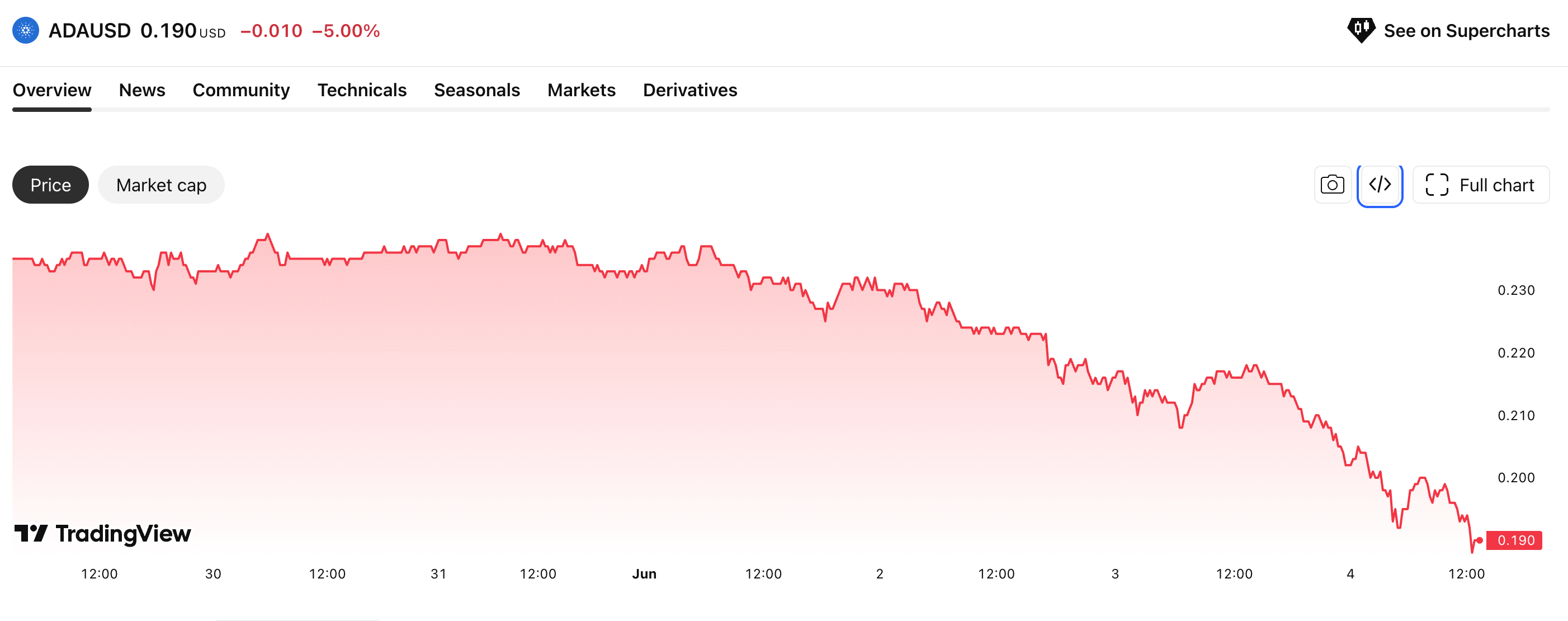
As of June 4, 2026, ADA is ranked #16 by market cap on CoinGecko, trading below $0.20.
The slide accelerated in March 2026, when Hyperliquid's HYPE token overtook ADA - a signal of how quickly capital is rotating toward protocols with actual revenue.
The situation got worse on June 3, when founder Charles Hoskinson announced he is "taking a break" after warning of a coming "wave of failures" in the ecosystem.
ADA dropped nearly 10% following his remarks, falling below $0.20 for the first time in over five years.
 Source: TradingView
ADA in Numbers: 2026 Data Snapshot
ADA opened 2026 around $0.40 and has been in a steady downtrend since, touching lows near $0.24 by late May. That's a year-to-date decline of roughly 40% on top of a 60% drop in 2025.
Market cap dropped from $7.89B on June 3 to $6.85B on June 4.
This single-day sell-off followed Hoskinson's warning of a coming "wave of failures" in the ecosystem.
24-hour trading volume around $870M. Circulating supply is 37B out of a hard-capped 45B ADA. Over 63% of that is actively staked across more than 3,000 independent stake pools.
 Source: DefiLlama
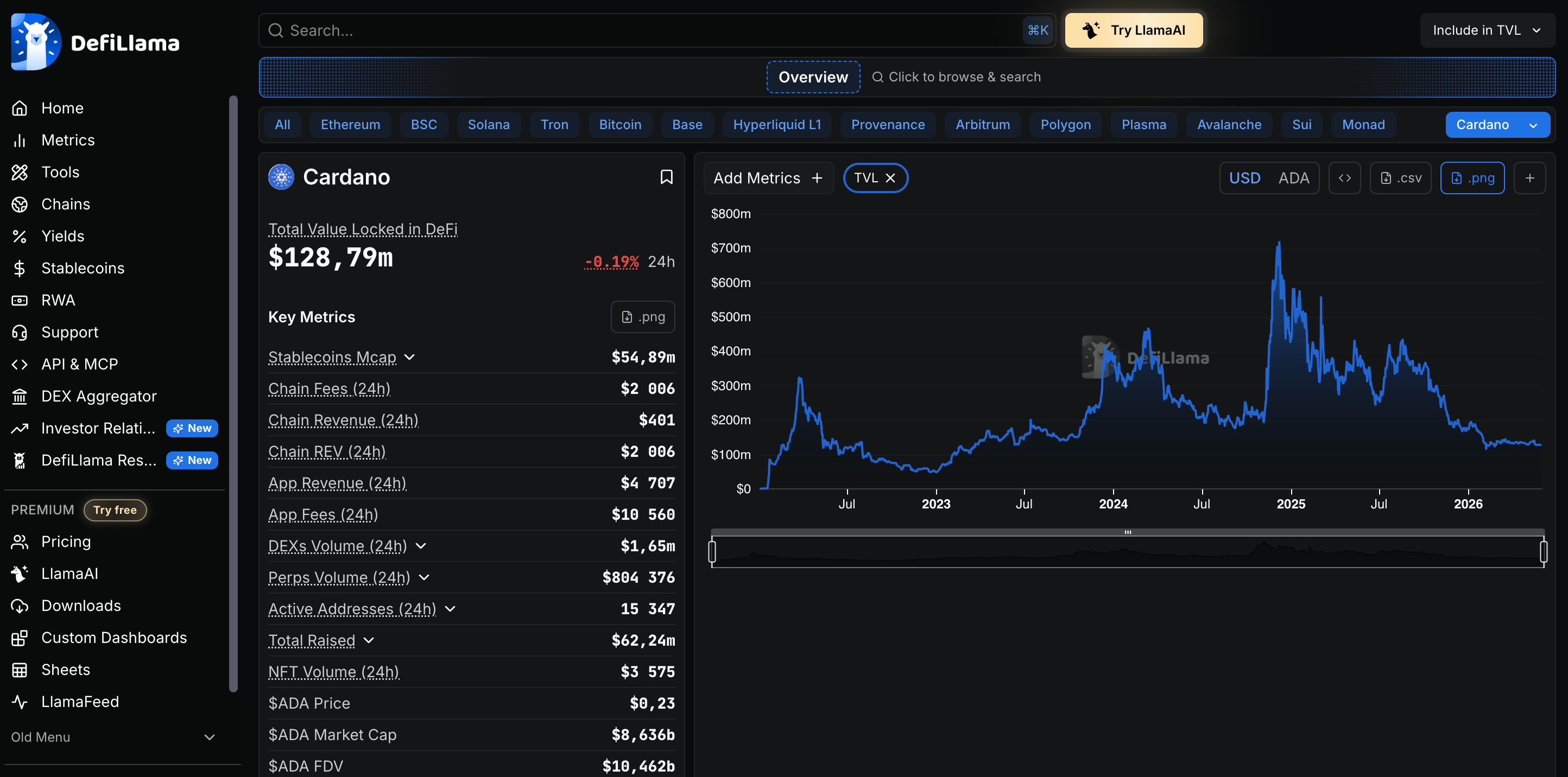
That same pressure is visible on-chain: as ADA's price fell, so did the economic incentive to deploy capital in Cardano DeFi, pushing TVL down alongside it.
ADA Price History
The pattern across every Cardano cycle is the same: the network builds during bear markets, the coin spikes on narrative, and then it underperforms when the hype fades.
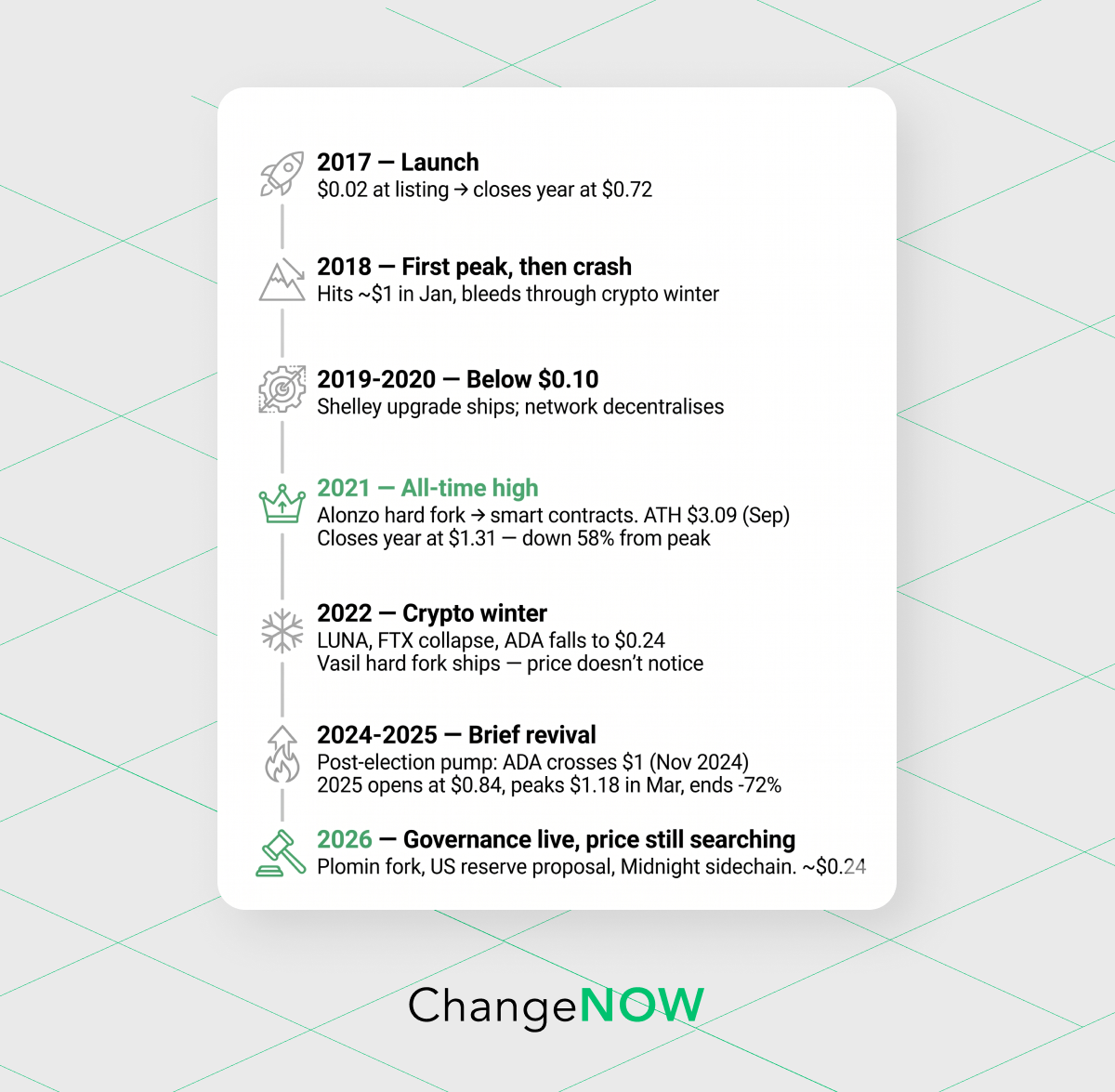
- 2017–2018 (Launch & first cycle): Cardano launched in September 2017 at around $0.02. It was swept up in the bull run, briefly crossing $1 before the crypto winter dragged it back down.
- 2021 (The all-time high moment): Development outpaced price until the Alonzo hard fork brought smart contracts. ADA hit its ATH of $3.09 in September. However, execution fell short of the hype, and ADA closed the year down 58% at $1.31.
- 2022 (The brutal bear): The Terra/LUNA and FTX collapses wiped out broad market sentiment. The Vasil hard fork shipped, but it didn't matter. ADA fell to $0.24.
- 2024–2025 (The reality check): ADA briefly crossed $1 again in late 2024 on post-election sentiment, but gave it all back. 2025 opened at $0.84, peaked at $1.18 in March, and ended the year down 72%.
Whether 2026 breaks this historical pattern is the actual question.
Why Investors Are Bullish on ADA
TL;DR: A lot is happening with Cardano in 2026: ETF filing, clearer regulations, new features for institutional use. The fundamentals are clearly improving.
ADA Spot ETF: Timeline and Odds
CME launched ADA futures in February 2026. That triggered the SEC's mandatory six-month waiting period before a spot ETF can be approved. The final decision deadline is October 23 if Grayscale files on that date. Bitwise and Canary Capital are also filing.
What this means for ADA price: right now, most institutional capital can't touch ADA. Pension funds, wealth managers, and large allocators work within compliance frameworks that don't allow direct crypto holdings.
A regulated ETF product changes that. Bitcoin's spot ETF pulled in over $35 billion in its first year. ADA's market cap is $8.86 billion. The math on what even a fraction of that demand does to price is straightforward.
CLARITY Act: What Commodity Classification Means for ADA
The CLARITY Act passed the House and would classify ADA as a commodity under CFTC oversight, removing it from the SEC's securities enforcement reach.
It's currently stalled in the Senate, but Polymarket gives it 72% odds of eventual passage.
For most institutional allocators, an asset with unresolved legal status is a hard no.
"Potential security" is a veto at the compliance level. "Digital commodity" is not. Passage would remove one of the longest-standing structural barriers to institutional ADA exposure.
Midnight Sidechain: Private Transactions for Enterprise Use
The Midnight sidechain went live on March 31, 2026. A sidechain is a separate, parallel blockchain connected to a primary network like Cardano to add new features without clogging the main chain.
Midnight's specific role is data protection. It allows smart contracts to run privately, meaning a transaction can be verified on-chain without publicly exposing what is inside it.
Think of it like a notarized document: the notary confirms it is real without reading the text. That lets banks and financial institutions process client data on-chain while staying compliant with AML and KYC requirements.
Neither Ethereum nor Solana offers this at the base layer. If enterprise adoption follows, it creates a use case, and fee revenue, that no other Layer 1 currently captures.
ADA Staking Rate vs. Ethereum
Around 59% of circulating ADA is actively staked, compared to roughly 28% for Ethereum.
Staked ADA doesn't circulate. When a large share of supply is parked, any increase in buying pressure hits a thinner market, which historically amplifies price moves in both directions.
Why Skeptics Are Cautious
TL;DR: The network isn't being used much, DeFi is bleeding capital, and the founder himself is warning of more failures ahead. Cardano has been "almost ready" for five years. The roadmap sure looks good. Execution record, less so.
Cardano Network Activity in 2026
Monthly fee revenue has fallen below $40,000. Fees are what users pay to transact and they're a direct measure of how much activity is actually happening on the network.
A chain generating less in monthly fees than a mid-sized restaurant does in a weekend is technically operational but not economically active.
Price without usage is speculation. Sustained price growth typically needs both.
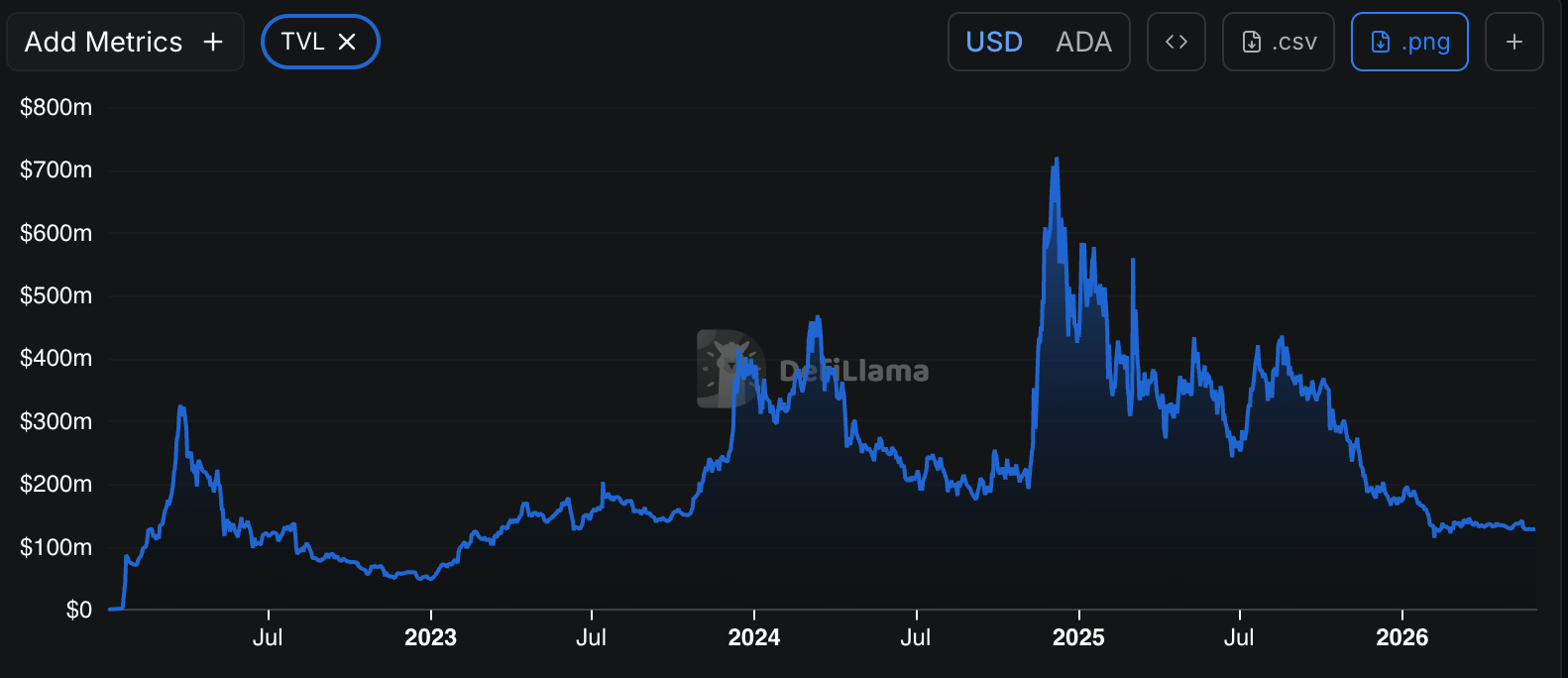
ADA DeFi TVL: Down 82% Since 2024
Cardano's DeFi TVL has plummeted 82% since its late-2024 market peak, dropping from over $700 million to just under $125 million.
 Source: DefiLlama
TVL tracks the total capital deployed across a network's decentralized applications. When it drops this sharply, it signals a compounding problem:
- Protocols are losing active users.
- On-chain yields are thinning.
- Developers lose the financial incentive to keep building.
Because crypto capital heavily concentrates where the activity already is, this macro decline makes an organic ecosystem recovery much harder to trigger.
When the Founder Is the Bear Case
It's one thing when outside analysts turn cautious on an asset. It's another when the network's own founder goes on record warning that a "wave of failures" is coming, and then announces he's taking a break.
🚨 UPDATE: Cardano founder Charles Hoskinson says he's "taking a break." pic.twitter.com/f2c4zxryS7
— Cointelegraph (@Cointelegraph) June 4, 2026
On June 3, Charles Hoskinson publicly acknowledged the ecosystem is under serious strain, citing the shutdown of TapTools, a community vote that killed the 2026 Cardano Summit, and broader difficulty getting treasury funds deployed to support builders.
Hoskinson's position is nuanced. He frames the failures as a market conditions problem, not a technology problem, and maintains the network has the foundation to recover. But the signal is hard to ignore: he predicted the second half of 2026 will be very hard, with more DeFi projects expected to fail before any rebound.
Cardano Development Track Record
Cardano has been in some version of "the next upgrade will change everything" mode since 2021. Smart contracts arrived late. Each hard fork reset the narrative. Each time, price moved on the announcement, then gave it back.
The 2026 catalyst list consisting of ETF, CLARITY Act, Midnight, Leios, and USDCx is concrete and verifiable.
The skeptic's read isn't that the upgrades aren't real.
It's that the market has already been trained to buy the narrative and sell the delivery.
Cardano Stablecoin Liquidity Gap
Stablecoins are the foundation of DeFi.
They're what protocols use to offer yields, what traders use to move in and out of positions, and what institutions require before deploying capital at scale.
Cardano has been thin on stablecoin liquidity for years. Circle's USDCx integration is in progress, but hasn't yet produced meaningful on-chain depth. Until it does, the DeFi ceiling stays low.
ADA Risk Assessment
TL;DR: ADA moves with Bitcoin, not just its own news. The ETF is the biggest near-term catalyst, and the biggest near-term risk if it doesn't happen. Everything else depends on whether Cardano can finally turn a strong roadmap into actual usage.
ADA is highly correlated with Bitcoin
ADA does not move on its own fundamentals alone. When Bitcoin drops, altcoins typically drop harder.
ADA erased most of its 2024 gains over the course of 2025 despite shipping real upgrades, largely because broader market sentiment turned bearish. Good news for Cardano specifically can easily get wiped out by a bad macro week.
We illustrated this exact ADA/BTC correlation trend in our recent article → Cardano Price Prediction 2026–2030
ETF Delay Risk
The spot ETF narrative is doing a lot of heavy lifting in the bull case right now.
An ETF delay or adverse SEC ruling could prolong the current bearish trend significantly. If that catalyst disappears, the next credible price driver isn't obvious.
On-Chain Governance: Still Unproven
The Plomin hard fork handed on-chain governance to ADA holders earlier this year.
That's a meaningful step toward decentralization. It also means protocol decisions now depend on community coordination, which is slower, messier, and less predictable than a core team making calls.
The success of Cardano's long-term roadmap depends on sustained execution under this new governance structure. It hasn't been stress-tested yet.
Slow Adoption as the Core Risk
The chain works. The code is solid. The risk is that Cardano keeps building features that don't attract enough users to matter competitively.
High volatility, intensifying L1 competition, and regulatory shifts are the three factors analysts most consistently flag when assessing ADA's downside.
None of them are unique to Cardano, but all three are present simultaneously right now.
Before You Invest in ADA
Before you jump into ADA, think of these questions as a quick reality check to help you figure out if it actually fits your personal strategy. No financial advice here, just food for thought.
- What's your time horizon? Most of ADA's catalysts: ETF approval, CLARITY Act, Leios, play out in 12–24 months at minimum. Short-term traders are betting on sentiment, not fundamentals.
- How much of your portfolio is already in altcoins? ADA moves with the broader market. Adding it on top of existing altcoin exposure concentrates your risk more than it diversifies it.
- Are you comfortable with low liquidity conditions? ADA is trading near its 2026 support floor at $0.24. Thin markets make exits harder when sentiment shifts fast.
- Do you understand the governance risk? On-chain governance is live but untested. Protocol decisions are now made by token holders. That process can be slow and unpredictable.
- What's your invalidation point? If the ETF gets rejected and the CLARITY Act stalls, what does the bull case look like? Have an answer before you're in the position.
Conclusion: Is Cardano a Good Investment?
That depends entirely on what kind of investor you are.
If you're looking at a 12–24 month horizon, Cardano has more genuine catalysts lined up than at any point since 2021.
A spot ETF window opening in August, a commodity classification bill with real odds of passing, a privacy sidechain live on mainnet, and, as of last week, stablecoin liquidity up 61%, with USDCx minting pushing Cardano to the top of weekly growth among major blockchains. The stablecoin gap that's been a structural drag on DeFi adoption is starting to close.
If you're looking at the next few months, the picture is less clear. ADA has been consolidating in the $0.24–$0.25 range, with selling pressure gradually weakening but no confirmed trend reversal yet. Analysts warn that a monthly close below $0.247 could signal deeper downside.
The honest answer is that Cardano is a project with strong fundamentals and a weak usage record. Those two things can coexist for a long time.
What changes that dynamic is execution in the second half of 2026.
For a deeper look at where experts think ADA is heading, see our Cardano Price Prediction analysis.


