Both tokens are pegged to physical metal sitting in audited vaults. From the outside, they look nearly identical. Same concept, similar price, competing claims about transparency and custody. So, what’s really the difference?
This article breaks down how PAXG and XAUt work, what separates them, and which one fits your situation.
When markets get shaky, investors look for something that holds value regardless of what central banks decide or what happens on Wall Street. Gold has played that role for centuries.
A few things are driving the current wave:
Inflation erodes cash. When the purchasing power of your dollars drops, hard assets like gold tend to hold their ground.
Geopolitical uncertainty is high. Wars, sanctions, and trade tensions push both governments and individuals toward assets no one can freeze or devalue.
Central banks are stacking. In 2025, central banks bought gold at near-record levels. When the people who print money are buying gold, it's worth paying attention.
Crypto investors want stability. Not everyone wants to ride Bitcoin's volatility. Tokenized gold sits inside the crypto ecosystem, but it's anchored to something real.
Of course, none of this means gold is a guaranteed win. But it explains the interest in PAXG and XAUt alongside the gold price itself.
PAXG & XAUt: Crypto Backed by Gold
Tokenized gold is a crypto token backed by physical gold stored in a vault.
1 token = 1 troy ounce of real metal.
You buy it and store it just like any other crypto asset.
Here’s the key features and differences between PAXG and XAUt, the top 2 tokenized gold tokens by market cap today.
PAXG: Gold Token by Paxos
PAXG is issued by Paxos - a regulated financial institution based in New York. Each token is backed by one troy ounce of physical gold held in Brink's vaults in London.
Paxos operates under a license from the New York Department of Financial Services (NYDFS). That means the company is audited and held to regulatory standards.
You can buy PAXG on ChangeNOW. The most popular swap direction is PAXG to USDT.
XAUt is issued by Tether - the same company behind USDT, the world's largest stablecoin. Each token is backed by one troy ounce of gold stored in Swiss vaults.
Unlike PAXG, XAUt is available on two blockchains: Ethereum and TRON. That gives more flexibility depending on which network you prefer or which fees are lower at the moment.
You can swap XAUt easily on ChangeNOW. You don’t even need to create an account. The most common pair is XAUt to USDT.
Both tokens do the same job. But how they do it, and who stands behind them is where things differ.
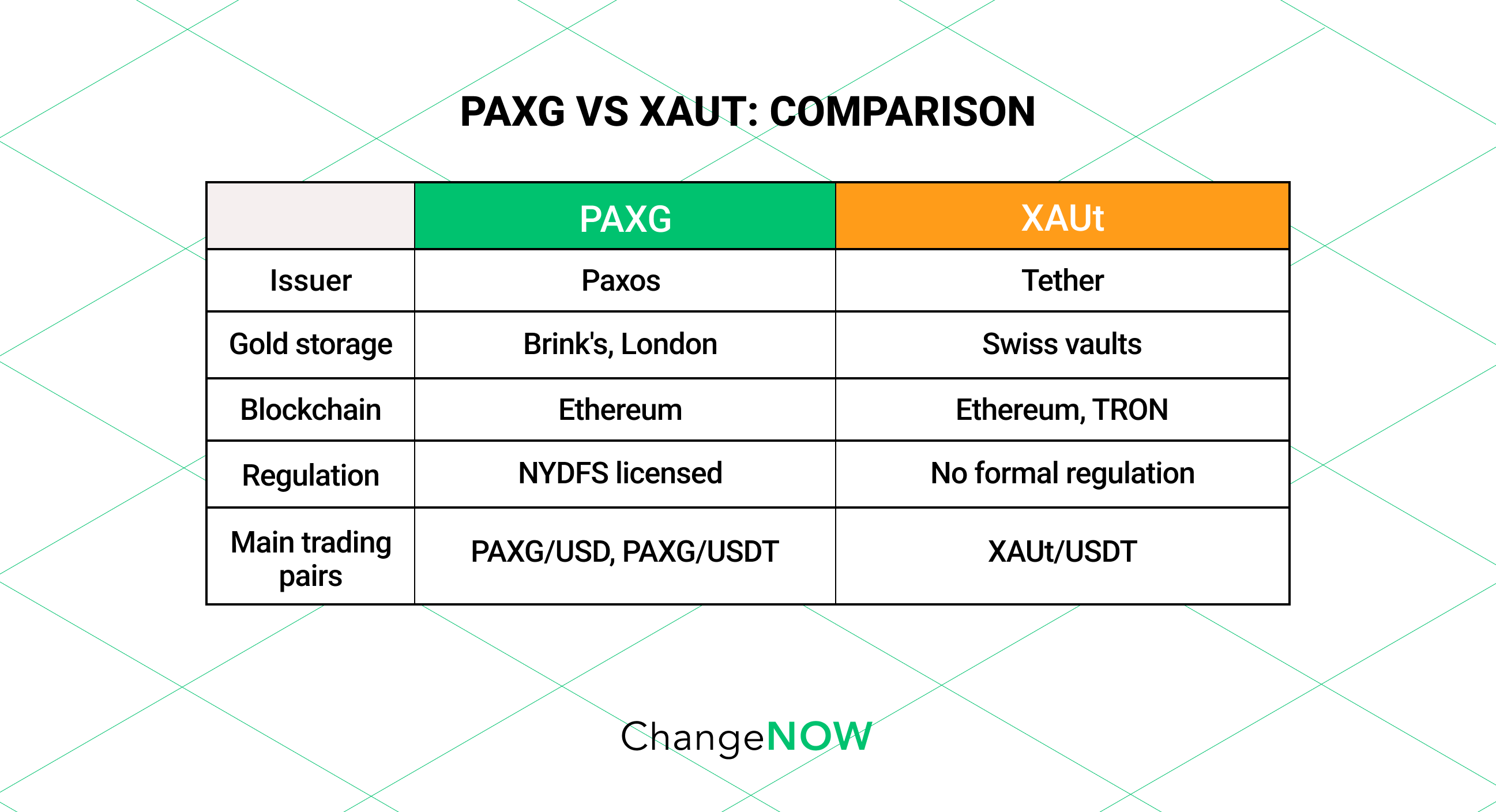
Gold storage. PAXG gold sits in Brink's vaults in London. XAUt gold is held in Swiss vaults. Both are professional-grade custody. But the real question here is how often someone checks them.
Blockchain. PAXG runs on Ethereum only. XAUt works on both Ethereum and TRON. If you're already active on TRON or want to save on gas fees, XAUt gives you that flexibility.
Regulation. Paxos holds a license from the NYDFS - the same regulator that oversees major US banks. That means external oversight, and not just promises from the project’s whitepaper.
XAUt has no equivalent license. For some investors, that's a dealbreaker.
Main trading pairs. PAXG trades against both USD and USDT - useful if you want to move directly into fiat. XAUt primarily trades against USDT. On ChangeNOW, you can swap both tokens in either direction.
PAXG Pros and Cons
PAXG Pros
Regulated and audited. Paxos is NYDFS-licensed and publishes monthly proof-of-reserve reports. You can verify the backing any time.
Higher liquidity. PAXG trades on more major exchanges and has higher daily volume than XAUt. That means tighter spreads and easier entry/exit, especially for larger amounts.
Direct fiat off-ramp. PAXG/USD is a native trading pair. You can move from gold to dollars without an extra swap through USDT.
Physical redemption. If you hold enough PAXG, you can redeem it for allocated gold bars with a specific serial number. Most holders never do this, but the option exists.
More flexible terms for physical redemption. Redeeming for physical gold requires a minimum of 430 PAXG for a full bar redemption. If you hold smaller amounts, you can redeem it in fractions through gold retailers partnered with Paxos.
PAXG Cons
Ethereum only. No TRON, no other L2 options. Ethereum gas fees can make small transactions expensive.
On-chain transfer fee. Market median on every PAXG transfer is 0.00019 PAXG ($0.89). Small for large amounts, but worth knowing if you move tokens frequently.
XAUt Pros and Cons
XAUt Pros
Two blockchains. Ethereum and TRON give you options. TRON transactions are faster and significantly cheaper. And that can be useful if you're moving tokens often or working with smaller amounts.
Tether infrastructure. If you're already using USDT, XAUt fits naturally into the same ecosystem.
XAUt Cons
No formal regulation. Tether operates without an NYDFS-equivalent license. That doesn't mean XAUt is unsafe, but it implies less external accountability.
Quarterly attestations, not audits. Tether publishes quarterly reports, and they're attestations - meaning a third party confirms the numbers Tether provides. A full audit is a more rigorous process. For most holders it won't matter day-to-day, but it's a meaningful distinction.
Lower liquidity. XAUt has less trading volume than PAXG across most platforms. For smaller trades it's fine. For larger positions, spreads may be wider.
Tether reputation risk. Tether has faced scrutiny over its reserves and transparency practices in the past. That history doesn't directly affect XAUt's gold backing, but it's part of the picture.
Higher bar for physical redemption. XAUt redemption requires a minimum of 430 XAUt tokens - just enough to cover one full gold bar (up to 430 fine troy ounces).
Physical delivery is available only to a Swiss address, with an additional fee of 0.25% of the gold price plus shipping. So, redemption stays an hypothetical option for most holders.
How to Swap USDT to PAXG or XAUt
Both PAXG and XAUt are available on ChangeNOW. You can buy, sell or swap any of the two tokens.
The USDT swap flow is the same for both:
Choose USDT on the needed network.
Enter the amount of PAXG or XAUt you want to get. ChangeNOW shows you the estimated rate before you commit.
Enter your wallet address. This is where your PAXG or XAUt will be sent. Make sure it supports ERC-20 tokens since both tokens run on Ethereum. XAUt holders can also use a TRON-compatible wallet.
Confirm the swap. The exchange processes automatically. Most swaps complete in a few minutes.
PAXG is a crypto token issued by Paxos. Each token is backed by one troy ounce of physical gold stored in Brink's vaults in London. It trades on Ethereum and is available on most major exchanges.
XAUt (Tether Gold) is a crypto token issued by Tether. Like PAXG, each token represents one troy ounce of physical gold, stored in Swiss vaults. It runs on Ethereum and TRON.
You buy XAUt on a crypto exchange. The token is pegged to the live gold price. Tether holds the equivalent amount of physical gold in Swiss vaults on your behalf. When you sell, you get the current market value, but not the gold itself, unless you meet the redemption requirements.
XAUt is backed by physical gold held in Swiss vaults by TG Commodities, S.A. de C.V. — Tether's custody partner. Each XAUt token represents one fine troy ounce of gold on a specific gold bar.
One XAUt token equals one fine troy ounce of gold just like PAXG.
In Brink's vaults in London. Each PAXG token is linked to specific allocated gold bars. Paxos publishes monthly proof-of-reserve reports so you can verify the backing at any time.
PAXG is one of the more transparent gold tokens on the market. Paxos is licensed by the NYDFS, publishes monthly audits, and stores gold in allocated Brink's vaults. No investment is risk-free, but PAXG carries fewer trust unknowns than most alternatives.
PAXG has a stronger regulatory profile: NYDFS license, monthly audits, allocated gold storage.
XAUt is backed by real gold too, but Tether operates without equivalent oversight and publishes quarterly attestations rather than full audits. If regulatory transparency is your priority, PAXG has the edge.
Depends on what you need. PAXG is better if you want regulatory oversight, higher liquidity, and direct USD trading pairs.
XAUt works better if you're on TRON, want lower transaction fees, or are already in the Tether ecosystem. Both are legitimate ways to hold gold on-chain.
TON vs GRAM vs Toncoin: Same, But Different, But Same?
Toncoin is becoming GRAM. And no, you don't need to do anything. Here's what's actually changing, what isn't, and how ChangeNOW is handling the transition.
Ethereum’s network activity is hitting ATHs, yet its token price recently collapsed to a multi-year low. Is this a temporary market shakeout ahead of the next major upgrade, or is ETH's economic model fundamentally broken?
Most crypto projects added an AI narrative after the market decided AI was the next big thing. NEAR Protocol had founders with machine learning backgrounds years before that trend existed.



 Source: